UPES B.Des Admissions 2026
Last Date to Apply: 30th May | Ranked #45 amongst Universities in India by NIRF | Ranked #1 in Academic Reputation in India by QS World University Rankings



Hi there, Candidates! In order to pass the National Institute of Design (NID) Mains test, prospective students must adequately study for "Design Scenarios," one of the several evaluation components. The NID Mains Scenario-based question and inquiries associated with this Section will be thoroughly discussed in this article and help students in preparation for the NID Studio Test. We'll go over every step to assist you turn these difficult situations into chances to perform well on the NID DAT 2026 Exam, from comprehending the issue statements to coming up with creative ideas, visualizing them, and presenting them.

Scenario based questions are the core component of the NID ‘Studio Test’ according to the NID DAT Exam Pattern which is the second stage of the NID Design Aptitude Test (DAT), unlike the objective-based NID prelims, the mains exam is very much focused on the practical and subjectivity based questions.
According to the NID 2026 DAT Exam Syllabus, Scenario based questions typically present a hypothetical/real-time situation , focusing on evaluating your hands-on skills, creativity and problem solving abilities. They are designed to assess a range of competencies required for being a good designer, as discussed below through an example
Last Date to Apply: 30th May | Ranked #45 amongst Universities in India by NIRF | Ranked #1 in Academic Reputation in India by QS World University Rankings
Last Date to Apply: 4th June | No. 1 Design & Fashion Institute by ASSOCHAM, India Today, Outlook and The Week rankings
PROBLEM STATEMENT
Design a portable shelter for the street vendor in Indian context which can be easily assembled and disassembled, providing protection from various weather conditions, and is aesthetically pleasing, but equally functional.
You may use the material as provided as follows:
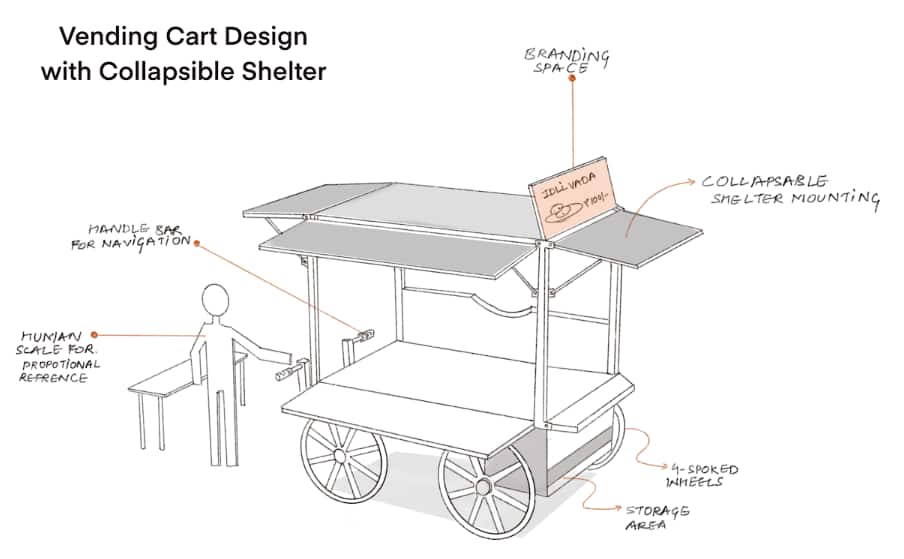
Sketched Solution
The above question is designed to assess your skills for
Problem Identification and Definition: Can you identify and grasp the ‘Core Challenge’ when thinking of a portable shelter for the street vendor in India.
Ideation and Conceptualization: How effectively can you generate diverse and innovative ideas, in response to the given scenario.
Visual Communication: Can you clearly and effectively communicate your ideas through sketches, models, or other visual means highlighting the part of solution and functional aspect of the challenge.
Understanding of the Material: Do you possess a basic understanding of different properties of the materials and their properties that could be harvested in your design solutions.
Creativity and Originality: How unique and imaginative are your solutions.
Related Articles students are advised to go through:
In order to approach the NID Mains scenario-based questions, one requires a blend of strategic thinking, and disciplined execution of the below discussed approach:
Before thinking of the solution, read thoroughly at least three times: first for understanding the gist, next to identify the keywords (like problem, user, function, materials, aesthetics, time limits), and last to unveil the secondary subtle constraints given passively.
Mark down the keywords and constraints (e.g., “portable shelter,” “street vendor,” “weather protection” etc. from the given scenario).
Infer Implicit Requirements: e.g., “portable” implies lightweight and quick assembly; “street vendor” suggests visibility and public use.
Tip: Generate quick thumbnails to visualise your thinking.
Brainstorm: List all ideas coming in your mind without judging the feasibility or practicality at this point of Ideation.
Mind Mapping: To connect concepts (materials, forms, user requirements).
Quick Idea sketches: Draw multiple variations to explore form and function.
Diverge, To converge: First, create diverse ideas; then shortlist 2–3 concepts that best match the brief, also it should not be your very first idea, since it may be very common.Use the Tools like Double-Diamond-Design thinking Model.
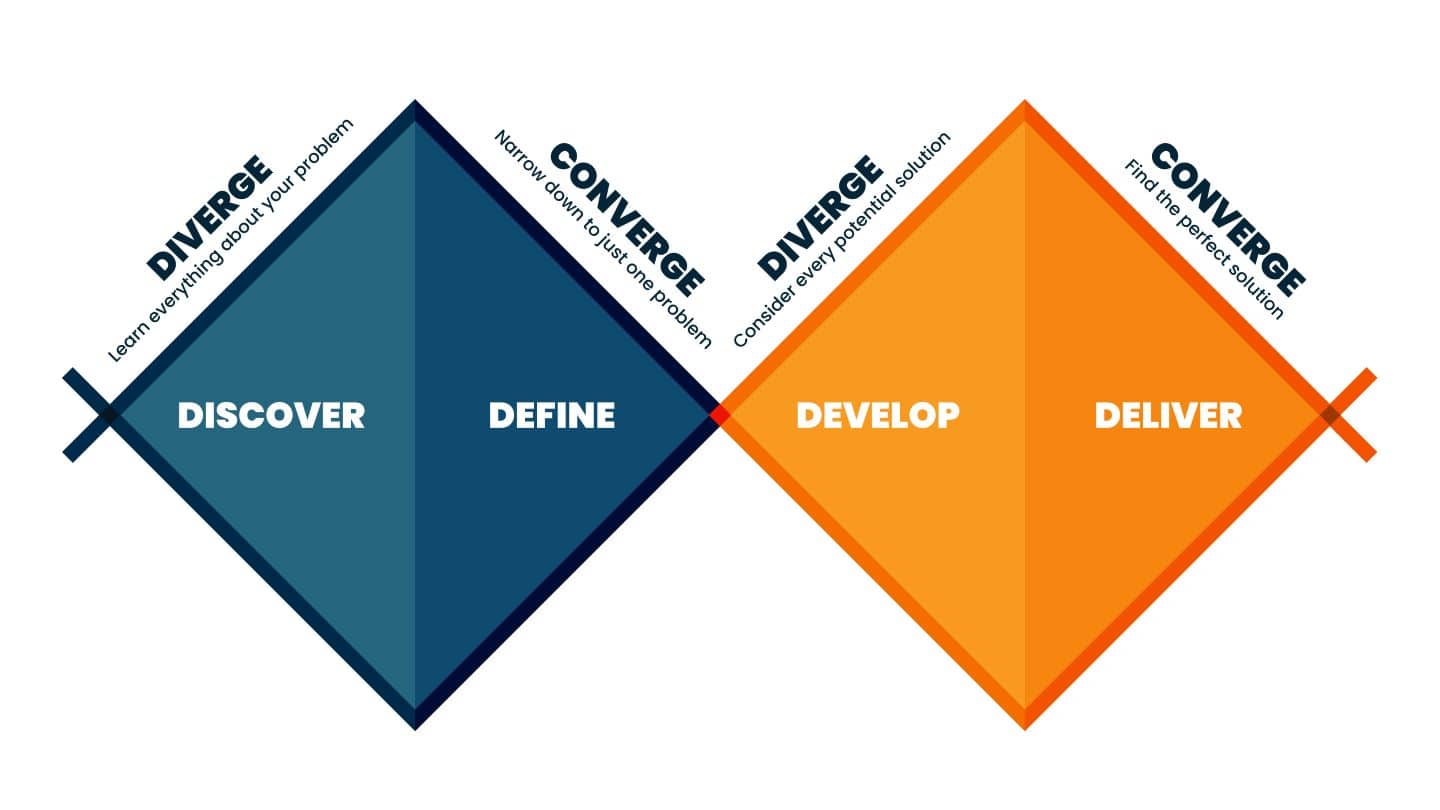
Tip: Visualise your mind map or idea sketches through professional toolkits and techniques like the Double Diamond method to reach the proper conclusion.
Related Articles:
The best way to think is to sketch and mention the details like dimensions, materials, folding methods, and mechanisms etc in the same drawing.
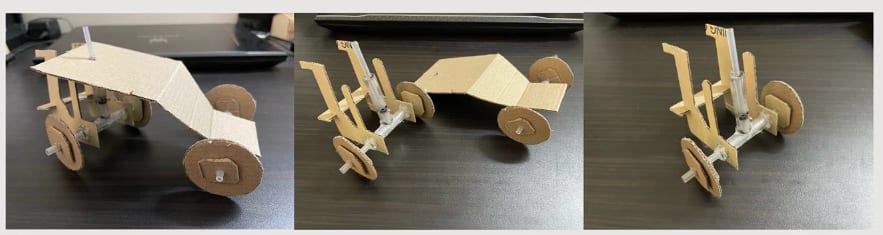
Material Exploration: Think about how the provided materials can be cut, folded, or reinforced to achieve the desired strength and functionality in the low fidelity model.
Overall presentations: The question may be asked for making the model or proposing the solution through design sketch only, in either case try to communicate the idea in a clear and crisp manner.
Tip: Create sketches/infographics highlighting key features and usability of the product.
Related Articles:
Plan your time Allocation: Ideally for a 20 marks question one should allocate max 15-17 minutes as per question following rule:
3-4-10 Rule for Scenario-based question of 20 Marks
03 minutes: For thinking, Deconstructing and evaluating the question requirements
04 Minutes: for Quick ideation sketches for a minimum of 03 alternative sketches to the proposed solution.
10 Minutes: For final execution through sketches, where the focus should be on clarity of the sketch and communication rather than the unnecessary details or shading.
Note: Even quick sketches should be legible; a clean model communicates ideas better.
Give a brief Title/Nomenclature to the subject : It is a healthy practice to give a brief title or nomenclature to your concept that could be used contextually to self-explain the attributes of the solution proposed.
Article students are advised to go through:
Show your design thinking: Explain how you weighed options, applied principles, or refined ideas through a quick comparison matrix if possible, comparing the feasibility and practicality in a tabular format.
Students may also check:

On Question asked by student community
Hello,
Preparing for the National Institute of Fashion Technology (NIFT) entrance exam involves focusing on several key areas. Here’s a structured approach to get you started:
Familiarize yourself with the NIFT entrance exam format:
No, diploma or polytechnic students are generally not eligible to apply for the NID DAT exam.
The eligibility criteria for NID DAT typically requires a 10+2 qualification or its equivalent. This means you must have completed your higher secondary education to be eligible for the exam.
I hope this information
Stages of the Exam:
The PG NID entrance exam typically consists of two stages:
As a Class 12 PCM student preparing for UCEED and NID, here’s a brief plan:
1. Focus on Creativity: Practice drawing, design exercises, and enhance your artistic skills regularly.
2. Math and Logical Reasoning: Use your PCM background to tackle quantitative and reasoning sections.
3. Stay Updated: Keep up with
Hello,
If you forgot to write the question paper code and date on your NID DAT prelims OMR sheet, contact the exam authorities immediately. They may have procedures in place to handle such situations. According to me there should be no problem for you even if you have not filled

Among top 100 Universities Globally in the Times Higher Education (THE) Interdisciplinary Science Rankings 2026
AICTE Approved | NAAC A++ | Category 1 University by MHRD | Highest CTC 1.4 Cr LPA from Amazon | Application Deadline: 14th May'26
Last Date to Apply: 4th June | No. 1 Design & Fashion Institute by ASSOCHAM, India Today, Outlook and The Week rankings
Integrative learning through a multidisciplinary process. Ranked Best Young Universities amongst Karnastaka
Outstanding Track Record in Placements.
Last Date to Apply: 30th May | Ranked #45 amongst Universities in India by NIRF | Ranked #1 in Academic Reputation in India by QS World University Rankings