UPES B.Des Admissions 2026
Last Date to Apply: 30th May | Ranked #45 amongst Universities in India by NIRF | Ranked #1 in Academic Reputation in India by QS World University Rankings



Hello Candidates! Students are now getting ready for the NID Studio Test, the final phase of the NID DAT Exam, after passing the NID Prelims. Students can overcome the practical, skill-based, and execution problems in the NID Exam Studio Test by using the crucial last-minute advice in this article. Your abilities in visual communication, creative thinking, empathy, and practical application of concepts will be assessed by the NID Mains. We provide you with a quick-reference table, comprehensive section-by-section techniques, and tried-and-true last-minute recommendations in this post to help you prepare for the NID DAT 2026 exam.
This Story also Contains

Before beginning the NID DAT preparation, one must be thorough with the exam pattern. As per the revised selection process , the NID DAT 2026 prelims result will not have any weightage in the final selection of candidates for B.Des and M.Des programmes. The NID 2026 prelims exam will be a qualifying exam to shortlist candidates for the mains exam. NID Mains exam will have 60% weightage for studio test and 40% weightage for in person interview for NID B.Des selection.
Aspirants preparing for NID Mains 2026 should give a quick look to this table below.
Work Area | Key Action (Quick Look) |
Concept Clarity | Defining your "Why" is critical |
Material Interaction | Practice rapid model-making from everyday objects and materials in the surrounding. |
Sketching | Sketch for clarity and communication not only aesthetics but functional understanding |
Practise Proportions & Scale | Ensure human-centric sizing and interactions in the real world with humans and products |
Presentation | Polish your final work neatly. |
User-Centered Design | Know your user and purpose of proposed design solution |
Adaptability | Develop the ability to Generate multiple ideas quickly and clearly. |
Instructions | Read and execute tasks precisely based on instructions given in the question paper without any ignorance. |
Related Articles:
Last Date to Apply: 30th May | Ranked #45 amongst Universities in India by NIRF | Ranked #1 in Academic Reputation in India by QS World University Rankings
Last Date to Apply: 4th June | No. 1 Design & Fashion Institute by ASSOCHAM, India Today, Outlook and The Week rankings
Aspiring students can go through some of these important last minute preparation tips in their effective preparation for the NID Studio Test to score high.
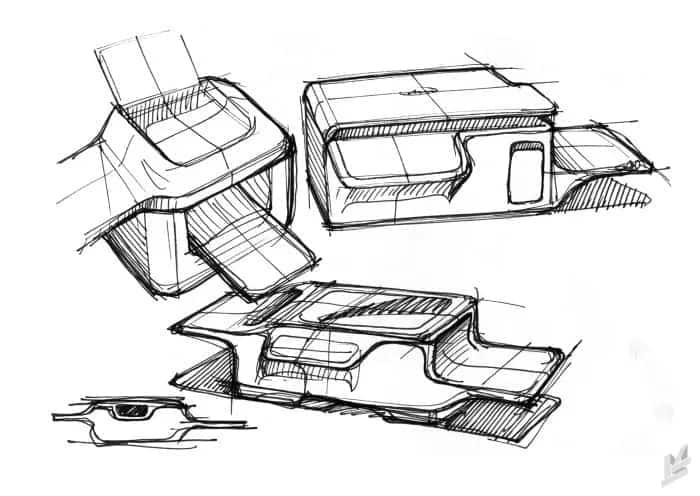
Sketch to communicate the idea, not to impress, by including infographics like arrows, clear labelling, backgrounds and quick ideas in the side to present the workable idea finally chosen as a reflection to the desired problem statement.
Include the following details in the sketches by providing the following:
Clarity in functionality
Quick Annotations
Clear Backgrounds
A Short description( if asked)
Often, during studio tests, students struggle to produce sketched or modelled outcomes with the right proportions, which creates an awkward imbalance of size. This gives an impression of an individual's lack of attention or aptitude. This skill set is crucial for reflecting a correct understanding of the real-world dimension and contextually fitting in the real world. In everyday life, try to understand the proportional understanding of objects, humans, and interaction (human-opening door handles).
Related Articles:
Start every design with a crystal-clear purpose because your “why” frames your design logic and is the framework to any further progress. Keeping ‘Why” in mind. How should each element you are integrating support your concept? The most common mistake is forgetting the “Why” part of the question before jumping to any execution.
For e.g., Sketch 3 quick variations of a “Modular Backpack” to simplify commuting for college students. Highlight different aspects of the model/proposed idea.
By practising Rapid Model, keeping the following aspects and understanding the details such as provided below would help you develop an edge to your model-making skill set.
Conceptualisation
Design development
User-experience
Sustainability
Production-Details (if possible)
This skill set is crucial for reflecting a correct understanding of the real-world dimension and contextually fitting in the real world.
Practise Exercise : You can begin with simple outdoor sketching or observation exercises, where the pencil can be used as the reference for all proportional understanding of the surroundings.
For example, suppose you wish to draw a building outside with details like windows, facade and other details, you may use a pencil of any other medium sitting at one place for referencing as shown below.

Related Articles students are advised to go through:
Examiners are often more inclined to clear communication through visuals and sketches. Focus on the following aspects of the presentation for both model-making exercises and sketching-based questions
Clear Marking and Annotations for Functional Components
Highlighting the major parts (using bold lines)
Use shading and hatching only for better time management
Support final concept with doodles to show your process
Avoid pencil smudges by keeping a layer of paper under palm
One most obvious mistake design aspirants do is ignoring the instructions or taking it granted for previous year instructions. However the evaluation schemes, question pattern and mode of examination keep on evolving with each gradual year, where reading instructions and reflecting accordingly for an efficient time management becomes crucial.
Commonly missed details or specifics are as follows:
Not reading the instructions carefully, like not using the colours
Wrong or unintended use of material for model-making
Missing Questions of Specific Instructions
Marking Related instructions
Representation or Any other instructions
User Centric design solutions are the solutions focussing on the user needs, preferences keeping functionality, accessibility and ease of use at centre when generating solutions. It showcases your ability to think practically, and overcome the challenges of a user through intuitive and effective ways of solving the problems.
Following are the key points for user-centric design:
Ability to empathise
Accessibility and Stakeholder Alignment
Using Personas and Journey Map to understand the requirements
Feedback loops and Stakeholder Alignment
Finally being a designer it is very crucial to remain abreast with the evolving design trends and new innovations. For NID DAT, students can also go through some online resources provided to quickly update yourself with trends and interesting projects.
It's critical to understand that success requires more than simply natural skill as we get closer to the last section of the Design Aptitude Test. It requires mental clarity while generating ideas, presence of mind, and astute use and implementation of the resources at hand. Achieving success requires the capacity to offer prompt, useful solutions while putting quality over quantity.
Article students are advised to go through:

On Question asked by student community
Hello,
Preparing for the National Institute of Fashion Technology (NIFT) entrance exam involves focusing on several key areas. Here’s a structured approach to get you started:
Familiarize yourself with the NIFT entrance exam format:
No, diploma or polytechnic students are generally not eligible to apply for the NID DAT exam.
The eligibility criteria for NID DAT typically requires a 10+2 qualification or its equivalent. This means you must have completed your higher secondary education to be eligible for the exam.
I hope this information
Stages of the Exam:
The PG NID entrance exam typically consists of two stages:
As a Class 12 PCM student preparing for UCEED and NID, here’s a brief plan:
1. Focus on Creativity: Practice drawing, design exercises, and enhance your artistic skills regularly.
2. Math and Logical Reasoning: Use your PCM background to tackle quantitative and reasoning sections.
3. Stay Updated: Keep up with
Hello,
If you forgot to write the question paper code and date on your NID DAT prelims OMR sheet, contact the exam authorities immediately. They may have procedures in place to handle such situations. According to me there should be no problem for you even if you have not filled

Among top 100 Universities Globally in the Times Higher Education (THE) Interdisciplinary Science Rankings 2026
AICTE Approved | NAAC A++ | Category 1 University by MHRD | Highest CTC 1.4 Cr LPA from Amazon | Application Deadline: 14th May'26
Last Date to Apply: 4th June | No. 1 Design & Fashion Institute by ASSOCHAM, India Today, Outlook and The Week rankings
Integrative learning through a multidisciplinary process. Ranked Best Young Universities amongst Karnastaka
Outstanding Track Record in Placements.
Last Date to Apply: 30th May | Ranked #45 amongst Universities in India by NIRF | Ranked #1 in Academic Reputation in India by QS World University Rankings